Public opinion report
The Observatory : Hate speech and racial discrimination have significantly increased in Lebanon
The International Observatory for Documentation of Human Rights Violations noticed in recent months the increase in hate speech, discrimination and racial incitement against foreigners in Lebanon at a noticeable and very high rate, specifically against the “displaced Syrians” and “Palestinian refugees” by a wide segment of representatives of political and populist parties in that country.
The Observatory believes that the most dangerous thing in what is happening is the racing and rushing of the majority of the “audible and visual” media to receive some “reputable” officials who “intend” to broadcast hate speech against the “displaced people and refugees”.This is the reason for campaigns of populist incitement and hatred in the streets, which result from time to time in campaigns of intimidating and brutal attacks targeting innocent “displaced people and refugees” and their security and personal safety and their children. Lebanese regions and the impunity of the aggressors or the issue and the provision of some media outlets with illogical justifications to falsify the facts in conjunction with the launch of campaigns calling for their expulsion from Lebanon.
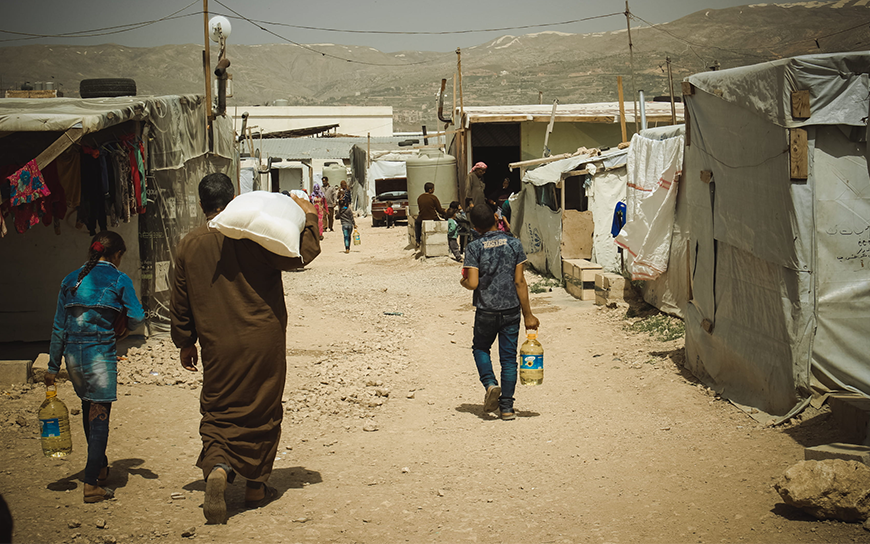
((The burning of camps inhabited by the “displaced Syrians” while they are “sleeping” in several Lebanese regions and the impunity of the aggressors or legal liability))
The past few days witnessed an attack on the “Syrian exodus” to Lebanon, and for the first time the repercussions of this attack reached the Council of Ministers, as Prime Minister Najib Mikati chaired on 5/7/2022 a meeting of the Ministerial Committee in charge of discussing the issue of the displaced Syrians, and threatened to deport the Syrian refugees. Forcibly in the event of the international community’s lack of cooperation with Lebanon, citing that “the situation is no longer bearable and the Lebanese state is no longer able to bear the cost of maintaining security in the camps for the refugees and the areas in which they are dispersed.”
On June 18, 2022, Lebanon demanded 3.2 billion dollars to address the repercussions of the Syrian asylum on its land, according to an official statement by the United Nations.
For its part, the organization said that it had provided 9 billion dollars in aid within the framework of the Lebanon Crisis Response Plan since 2015, but the successive “Lebanon” crises plunged large segments of the Lebanese into extreme poverty, and exacerbated with it public dissatisfaction with the continued presence of Syrian refugees.
And “Lebanon” (which in 2020 defaulted for the first time in its history to pay its foreign debts) is suffering from a dwindling dollar reserve, which made the authorities unable to provide the most basic services such as fuel, electricity and medical care, due to the deterioration of state utilities services.
On the other hand, the “Palestinian refugees” in “Lebanon” suffer misery, the pain of asylum, cases of oppression and the high rate of poverty and unemployment, where their marginalization is still an unchanged reality, as the Lebanese political and legal class constitutes an expelling environment for the Palestinians under the pretext of preventing their resettlement, but the truth is that the Palestinians do not
want originally localization , rather, they desire fair humane treatment, as racial discrimination extends against them from Lebanese laws that deprive the “Palestinian refugee” of the minimum human rights in addition to the social and political rights enjoyed by any immigrant or refugee in all countries of the world, including the “Lebanese expatriates.”
((Lebanese law prevents Palestinians from practicing most professions, which makes them one of the groups most affected by the economic crisis))
A larger section of the (politically oriented) Lebanese distribute “ implacability” and drop their hatred on strangers, “Syrians and Palestinians”,they even pour out their anger on them, starting with securing the “bread bundle” and passing through the “gas bottle” and “food security”, then securing “job opportunities” and then securing “houses for living ”, and even calling for them to sell the “Corona Virus” vaccines that have taken place. It is free of charge by the Lebanese state, in addition to the spread of crimes against them, the increase in kidnappings, the bargaining of the kidnapped and rape, and the very bad and degrading treatment of human dignity. We have documented many incidents that took place in Lebanon since the beginning of 2020 until now.
((Lebanon obtained free coronavirus vaccines from European governments with the aim of granting them to citizens and residents (displaced and refugees) on Lebanese soil))
Based on what was mentioned, the “observatory” reminds the officials in “Lebanon” of the size of the economic imports that “Lebanon” receives due to the international aid for “displaced people and refugees” that goes to the state treasury and not to the concerned stakeholders.
The International Observatory for Documentation of Human Rights Violations warns of the growing intensity of hate speech in Lebanon, and calls on the Lebanese state, with all its bodies, to fulfill its obligationsl under International Law, the International Covenant on Civil and Political Rights and the International Covenant on Economic, culture and social rights and the Universal Declaration of Human, and because the Lebanese government authorities bear the main responsibility for preventing incitement to discrimination and hatred against the “displaced Syrians” and “Palestinian refugees” in “Lebanon” and protecting the Lebanese society from crimes, we stress that dealing with immigration and asylum issues will not take place from a purely security perspective, and we demand as follows:
- Legally and legislatively enact the right of “displaced Syrians” and “Palestinian refugees” in “Lebanon” to obtain all the privileges available to members of the Lebanese society, in areas covered by the law.
- Canceling and combating all forms of discrimination against “Syrians and Palestinians” in Lebanon, personal (individual) discrimination, legal discrimination, and institutional discrimination.
- Legally ban any advocacy of national, racial or religious hatred that constitutes incitement to discrimination, hostility or violence against the “Syrians and Palestinians” in Lebanon.
- Legislate that the dissemination of ideas based on racial superiority or hatred, and all incitement to racial discrimination and every act of violence or incitement to such acts are committed against any “race” or “group” of any other “colour” or “origin”; Likewise, any assistance to racist activities, including its financing, is a crime punishable by law.
- The commitment of the “Lebanese government” to protect public order and the human dignity of “displaced persons and refugees,”prohibition of public or implicit incitement to hatred, advocating violence, calling for arbitrary measures against them or insulting them, or directing hostile appeal or slander in a manner that violates their human dignity, and criminalizing these practices and can be prosecuted as an accusatory crime and punish the perpetrators of these crimes, and that the practice of racism is not released on bail and does not fall The statute of limitations and imprisonment under the provisions of the law.
- Freedom of expression is respected in all Lebanese territory, but anyone who violates human rights and fundamental freedoms recognized by the international community is punished on the basis of a difference of “race”, “religion”, “language”, “belief”, political or any other belief, or on the basis of wealth, birth, education, social status, material possessions, gender, skin color, nationality, or ethnicity.
- That the educational programs in Lebanese schools establish and commit to reporting incidents of discrimination, racism and hate speech.
- The legal prohibition in schools and universities from using insulting expressions or nicknames targeting individuals from the “Syrians and Palestinians” in Lebanon.
The Observatory also calls on the Lebanese Ministry of Information and all “media institutions” in Lebanon to:
- Prohibition in the media from allowing expressions of humor or satire that some may consider threatening or offensive, for example: jokes, short comedies, popular song lyrics, etc.
- It is prohibited in the Lebanese press and public and private communication channels any defamation or insult, or incitement to discrimination, hatred or violence against a person or group because of the place of origin, race or their lack of knowledge, nationality, race, particular religion, gender or sexual orientation or physical disability.
- It is prohibited to use and launch discriminatory, racist and hate speech on certain political and electoral opinions and statements to silence inappropriate or critical opinions and to suppress debates.
- Prohibition in the media and politics of the use of racist, discriminatory and hate speech; To achieve political gains in public life through the dissemination of a hostile discourse directed against the displaced, immigrants and refugees “Syrians and Palestinians” or others in “Lebanon” and the so-called “other”. As hate speech weakens and destroys societies, it also works to sow the seeds of fear, hatred and mistrust in the souls of its members.
The Observatory calls on the Human Rights Committee in the Lebanese Parliament and the effective “human rights institutions” to intensify the conduct of local training courses and dissemination of education on the dangers of discrimination, intolerance and hatred, and to work on building a national
strategy to combat the discourse of racism, discrimination and hatred that helps to commit and encourage acts of violence. Finding the best ways and means to combat and prevent this discourse. Including:
- Raising awareness by conducting local training sessions and educating friends and family members about the dangers of discrimination and intolerance.
- Report social media posts that spread rumors or misinformation.
- Flooding the space of social media and electronic platforms with positive messages calling for peace and tolerance.
- Support individuals or groups targeted by hate speech and encourage policy makers to take action against discriminatory language or policies.
- Host conflict-sensitive journalism workshops to help journalists develop the ethical capacity to identify sources of conflict and report fair and accurate news.
- Forming early warning and response committees at the national and local levels to monitor hate speech and other forms of incitement to violence.
‘Press report finished’
International Observatory for Documentation of Human Rights Violations
/Media Section
Argentina – Buenos Aires
06/08/2022
(The International Observatory for Documenting Human Rights Violations), is an independent Argentine international center, registered in accordance with the laws of the Republic of Argentina, as a non-governmental, non-profit organization, working with the aim of defending human rights and documenting violations around the world. It was established on the tenth of December 2015, and obtained the license Official from the Argentine government in the year 2021. The members of the observatory cover their activities in 64 countries.
We are a team of people who are interested and believe in the protection of human rights, in all countries of the world, especially in countries where defenders are subjected to the most severe direct targeting campaigns.