
Press release for public opinion
The Observatory: The Russian invasion of Ukraine is an act of Aggression and a Serious Human Rights Catastrophe
The International Monitor for Documenting Human Rights Violations considers the Russian invasion of Ukraine a clear violation of the Charter of the United Nations and an act of aggression, and it is a crime under international law, and all those involved in this crime must be held accountable for those violations from the beginning of their invasion of Ukraine until now.
In the context of stressing the seriousness of the Ukrainian crisis, the “Observatory” calls on the member states of the United Nations to uphold the charter of United Nations, which prohibits the use of force against the territorial integrity or political independence of any country.
The Observatory noted that the only exceptions to these provisions are self-defense and the use of force under the authorization of the United Nations Security Council – neither of which applies to the ongoing crisis, emphasizing that under international law, all states are required to settle international disputes by peaceful means and in a manner that does not jeopardize international peace, security and justice.
Human rights organizations emphasized in their reports that “the Russian invasion of Ukraine has caused a massive human rights crisis, a humanitarian crisis, and a displacement crisis that led to the worst such catastrophe in modern European history, and that Russia does not violate the sovereignty of a neighboring country and its people, but it is also challenging the global security architecture.
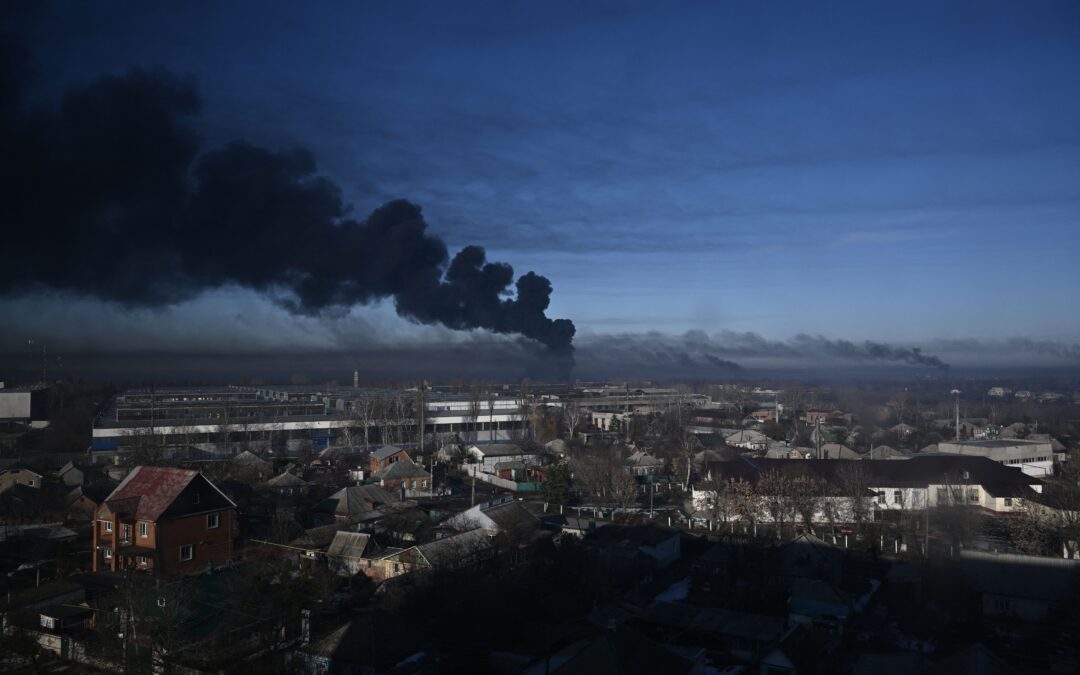
Since the start of the Russian invasion on February 24, many international organizations concerned with defending human rights have documented the escalation of violations of international humanitarian law and international human rights law, including the killing of civilians as a result of indiscriminate attacks on civilian areas and targeting of infrastructure.
The bombing of protected objects such as hospitals and schools, the use of indiscriminate weapons such as ballistic missiles, and the use of prohibited weapons such as cluster bombs may all amount to war crimes.
The International Monitor for Documentation of Human Rights Violations calls on the member states of the United Nations to stand united in condemning the crimes of Russian aggression, providing relief and assistance to the citizens of Ukraine, including those fleeing the conflict, and ensuring that the consequences of Russian aggression are not allowed to push the world closer to the abyss of Violence, abuse and insecurity.
The Observatory also welcomes the announcement by the Prosecutor of the International Criminal Court that his office will seek to open an investigation into Ukraine and place all perpetrators of war crimes and crimes against humanity committed in Ukraine – including those who hold higher and more responsible positions – under penalty of individual accountability.
The Observatory also calls on all international organizations to unite efforts to collect and preserve evidence because it is crucial to the success of future investigations.
It must also work to urge European governments to advocate for victims of war crimes in the development of a comprehensive plan to secure redress, reparation and compensation for their suffering.
Background:
Serious violations of the rules of conflict constitute war crimes. Some of them have been codified as such in the Rome Statute of the International Criminal Court.
The International Criminal Court has jurisdiction over war crimes committed in Ukraine, which issued a declaration in 2015 accepting the jurisdiction of the International Criminal Court for crimes committed on its territory since February 20, 2014. Russia signed the Rome Statute in 2000 but withdrew its signature in 2016.
Russia’s military intervention in Ukraine appears to fit the definition of the crime of aggression under the Rome Statute of the International Criminal Court.
Article 8 of the Rome Statute defines, in the relevant part, the “crime of aggression” as “an act of aggression which, by its characteristics, gravity and scope, constitutes a clear violation of the Charter of the United Nations.”
Although the Court, except for an unlikely referral by the Security Council, would not have jurisdiction over the crime of aggression in this case, a number of countries, including Ukraine, have domestic laws that allow for the prosecution of those responsible.
The invasion of Ukraine already resulted in indiscriminate strikes on residential areas, medical institutions, social infrastructure and other civilian objects and infrastructure, and resulted in civilian deaths and injuries.
It has led to mass displacement and the destruction of civilian homes. The hostilities in Lugansk and Donetsk, particularly in 2014-2015, saw extrajudicial executions, torture and other ill-treatment, enforced disappearances and unlawful deprivation of liberty.
International Observatory for Documentation of Human Rights Violations /Media Section
Argentina – Buenos Aires
07/03/2022
(International Observatory for Documentation of Human Rights Violations), is an independent Argentine international center that operates as a non-governmental organization registered in accordance with the laws of the State of Argentina, with the aim of defending human rights and documenting violations around the world. of the United Nations, a founding member of the International Organization for Human Rights and International Law, and registered in the database of the Fundamental Human Rights Agency of the European Union, and headquartered in Argentina. The members of the Observatory cover their activities in 64 countries. We are a group of people who are interested and believe in the protection of human rights, in all countries of the world, especially in countries where defenders are subjected to the most severe direct targeting campaigns.


